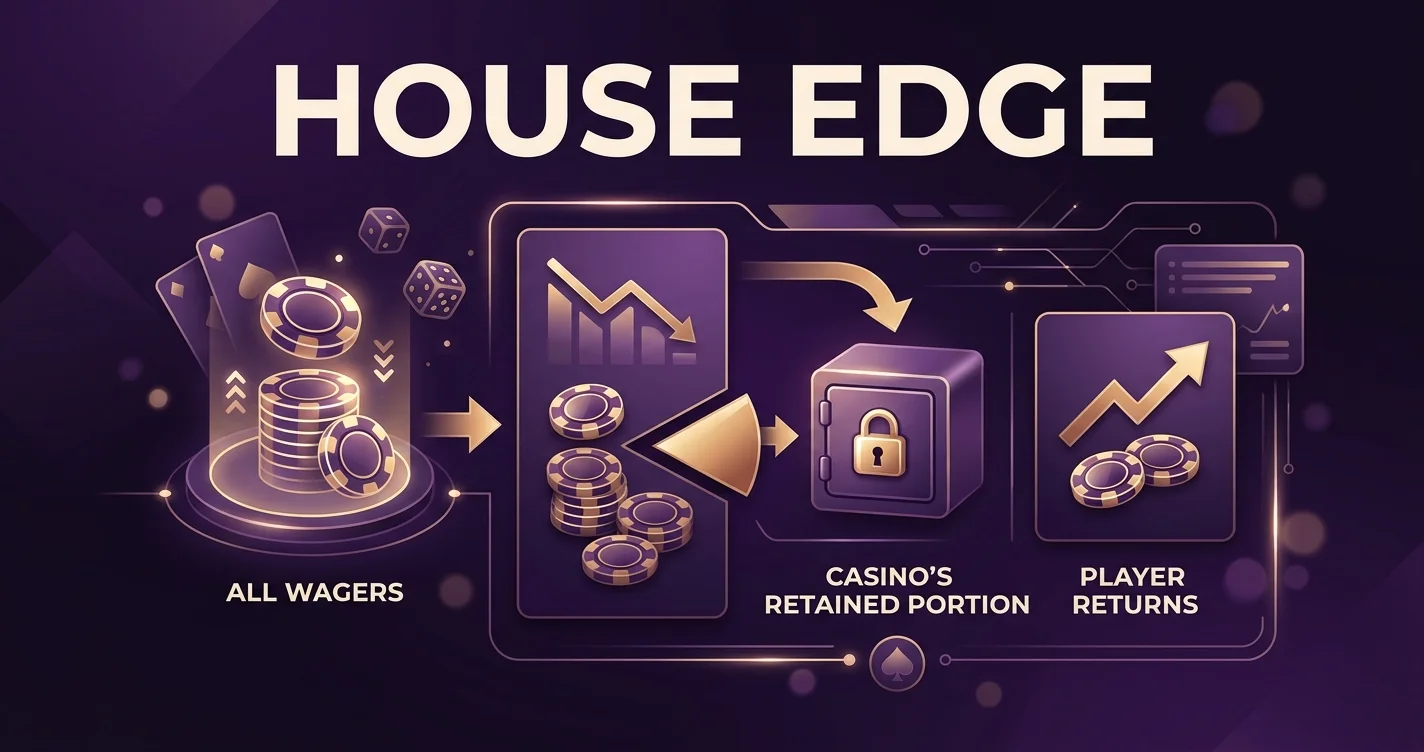
The house edge is the mathematical share of every bet that the casino keeps on average over the long run. If a game has a 3% edge, then for every 100 UAH wagered, the player's expected loss is 3 UAH on average. This is not a promise that you will lose in any particular session, but an average result over a very large number of games.
How the house edge works
Every gambling game is designed so that payouts are slightly lower than the true probability of the event. The difference between the "fair" payout and the actual one is the house edge. It is built into the rules of the game or the slot's settings, so it does not depend on the time of day, your mood, or how much you have already lost.
The main formula is simple:
- Expected loss = total amount wagered (turnover) × house edge.
Note that what counts is turnover, not your deposit. If you deposited 1000 UAH but placed bets totaling 20,000 UAH over the evening (because winnings were played again), the edge applies to those 20,000 UAH.
The link to RTP
For slots and many other games, RTP (return to player) is often listed instead of the house edge. It is the percentage of wagers the game returns to players over the long run. The relationship is direct:
- house edge = 100% - RTP;
- an RTP of 96% means a house edge of 4%;
- an RTP of 94% means a house edge of 6%.
A difference of two percentage points seems small, but it matters. For every 1000 UAH wagered, the expected loss is 40 UAH at 96% RTP and 60 UAH at 94% RTP. That is 1.5 times more, or 50% higher, on the same turnover.
Example 1: roulette
European roulette has 37 pockets: the numbers 1 to 36 and a zero. A bet on a single number pays 35 to 1. Let's calculate the average result of a 1 UAH bet:
- a win with probability 1/37: we receive +35 UAH;
- a loss with probability 36/37: we lose 1 UAH;
- average: 35/37 - 36/37 = -1/37, or roughly -2.70%.
The house edge in European roulette is about 2.70%, and it is the same for most bets on the table. American roulette also has a double zero (38 pockets), so the edge there is about 5.26%. It is a clear example of how a small change in the rules nearly doubles the edge.
Example 2: a slot with 96% RTP
Suppose you are playing a slot with 96% RTP and betting 10 UAH per spin.
- You make 300 spins: turnover of 3000 UAH.
- House edge of 4%: expected loss is 3000 × 0.04 = 120 UAH.
This is an average, and the actual result can differ widely. If you started the session with 1000 UAH, you could finish 500 UAH up, or you could lose the whole starting balance long before the 300th spin. The 120 UAH figure only describes what happens on average across a very large number of spins.
Why players still win
If the edge is always on the casino's side, how do people win at all? Because of variance: random fluctuations of the result around the average. Over a short period they are far larger than the edge itself.
Imagine a coin that lands on your side 49% of the time. Over 10 flips you could easily win six times. Over 100,000 flips the result will be very close to 49%. The same goes for casinos: the larger the combined turnover of all players, the more closely the real revenue matches the calculated figure. For an individual player this means two things:
- one successful session says nothing about a "broken" system;
- the longer and more often you play, the more your result tends toward the expected loss.
The edge in different games
The edge is not the same everywhere. Here is a rough overview of the games in general terms:
| Game | What the edge depends on | Benchmark |
|---|---|---|
| European roulette | A single zero on the wheel | about 2.70% |
| American roulette | Zero and double zero | about 5.26% |
| Blackjack | Table rules and your strategy | can be small with skilled play, but varies from table to table |
| Slots | The settings of the specific game | listed as RTP in the game information |
| Baccarat | Choice of bet (banker, player, tie) | the tie bet is usually much worse than the others |
The practical takeaway: before you play, look at the rules and the RTP. For slots, this figure can usually be found in the game information section. Within the same category of games there can be different settings, so you should not assume that all slots are the same.
The house edge and bonuses
A bonus looks like a gift, but the edge math applies to it too. A bonus has to be wagered, meaning you must place bets totaling a certain amount. That multiplier is called the wagering requirement, and this is where the edge shows itself most clearly.
A hypothetical example (the figures are made up for the calculation):
- a 1000 UAH bonus with a x30 wagering requirement: you need to place bets totaling 30,000 UAH;
- a game with a 4% edge: the expected loss while wagering is 30,000 × 0.04 = 1200 UAH.
In other words, on average the wagering "eats" more than the bonus itself. That doesn't mean bonuses are always a bad deal: variance works in your favor too, and playing with a bonus gives you more time at the game. But it should be assessed soberly: a bonus does not cancel the house edge, it only changes the conditions of play. The lower the wagering requirement and the higher the RTP of the games that count toward it, the milder this math is.
Cashback and rakeback
Cashback and rakeback slightly reduce the effective edge, but do not eliminate it. At RichTop, rakeback is a percentage of every real bet, with no wagering requirement and paid straight to the main balance, while cashback is credited weekly as a share of losses depending on the VIP level. A hypothetical example: if a game's edge is 4% and rakeback is 0.5% of the bet, the effective edge is roughly 3.5%. That is still a loss on average, just a slightly smaller one.
Bonus buy
In slots with a bonus buy feature, the player pays for instant entry into the bonus round. The house edge does not disappear. The RTP of the buy mode can differ from the RTP of regular play, so it is worth checking this figure in the information for the specific slot. Because such a purchase is a single, much larger bet, turnover and expected loss in UAH grow faster.
Common mistakes and myths
"The slot hasn't paid out for a long time, so it will pay soon"
This is the so-called gambler's fallacy. Every spin is independent, and the game does not "remember" previous results. The edge applies to each bet separately and does not even out within your session.
"Betting systems beat the casino"
Progressions, such as doubling your bet after a loss, change the shape of the risk but not the edge itself. Such a system can produce many small wins and a rare big loss. The final expected loss still equals turnover multiplied by the edge, and with these progressions turnover even grows. On top of that, bet limits and your balance do not allow you to double indefinitely.
"A high RTP guarantees a win"
An RTP of 97% does not mean you will get 97 UAH back out of every 100. It is an average across a huge number of spins by all players. Your particular session can end with a complete loss or a significant win.
"The edge depends on the time of day or bet size"
No. The edge percentage is built into the rules of the game and does not change whether you play by day or by night, with a large bet or a small one. Only the absolute amount in UAH changes: with a larger bet, turnover and expected loss are higher.
"If I lower my bet, the edge will shrink"
The percentage stays the same, but the expected loss in UAH over the course of play really is smaller, because turnover is smaller. So bet size is a way to manage the cost of entertainment, not a way to beat the edge.
How this helps you make decisions
- Look at the RTP. If you have a choice between games of a similar type, the game with the higher RTP has a lower house edge.
- Count your turnover. Estimate in advance how many spins you will make: bet × number of spins × edge gives you a benchmark for the cost of the evening.
- Evaluate bonuses by their terms. Convert the wagering requirement into bets in UAH and think about how much such wagering costs on average. Read which games count and with what contribution.
- Plan your budget as an entertainment expense. It should be money you are ready to spend in the same way as on a movie or a dinner, not a way to earn income.
- Don't chase losses. Trying to "win it back" increases turnover, and therefore the expected loss.
Responsible gambling
Knowing about the house edge reminds you of the main point: over the long run, gambling has a negative mathematical expectation for the player, and no strategy changes that. You can only play from the age of 18. Set deposit and time limits, don't gamble with money you need to live on, and take breaks. If you feel that your play is getting out of control, at Rich Top you can use self-exclusion for a period from 6 months to 5 years, and you can also contact the support team, which works around the clock.
In brief
- The house edge is the average percentage of bets that stays with the casino over the long run.
- It equals 100% minus RTP.
- Expected loss = turnover × edge, so it is affected by the number and size of bets, not just your deposit.
- Over the short term, variance can produce both a win and a loss that differs greatly from the average.
- Bonuses, cashback and rakeback change the conditions of play, but the mathematical edge remains. Before playing at Rich Top or any other casino, it is useful to calculate the expected cost of play rather than rely on the feeling of a "lucky streak".





 Google

 Payment History