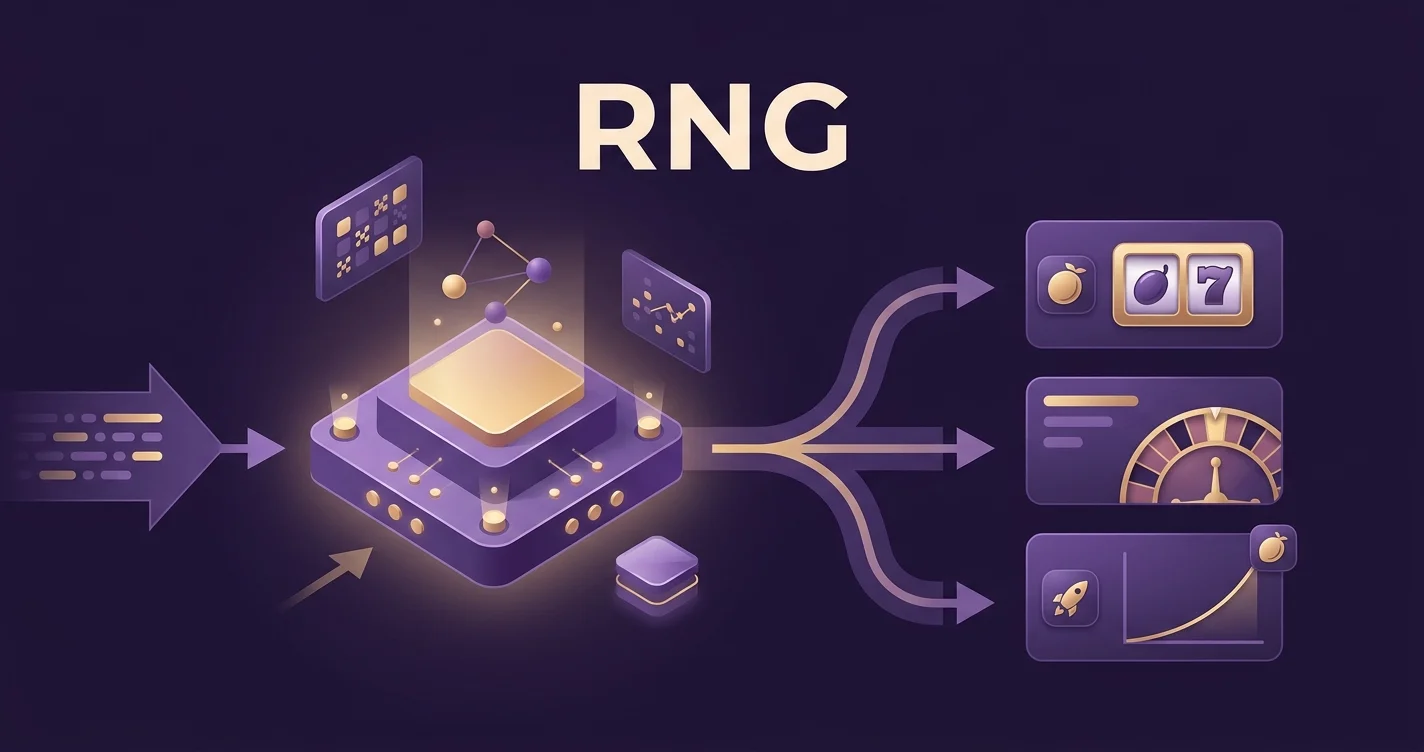
An RNG (Random Number Generator) is a software algorithm that constantly produces numbers with no visible pattern. In slots, virtual-wheel roulette, crash games and many other games, these numbers decide what comes up in your round. The result does not depend on previous spins, the time of day or the size of your bet.
How an RNG works in simple terms
Imagine a huge counter that flicks between millions of values nonstop, even when nobody is playing. When you press "Spin", the game captures the current number from this stream. Then, using a predefined table, that number is converted into an outcome: a set of symbols on the reels, a card, a number on the roulette wheel.
In other words, the result is determined at the moment you press the button, not when the reels stop. The animation merely shows what has already been decided.
True randomness and pseudo-randomness
Most game RNGs are pseudo-random (PRNG). They calculate numbers using a complex mathematical formula that starts from an initial value (called a seed). It sounds as if the result could be predicted, but in practice that is unrealistic:
- the formulas used in game software are very complex, and their repetition period is enormous;
- the seed is taken from unpredictable sources, such as the exact time in microseconds or system events;
- the player sees neither the generator's current state nor the intermediate numbers.
For practical purposes, such a generator behaves as if it were truly random. That is why similar algorithms are also used in fields where security is critical.
How a number becomes symbols
The generator does not output a "cherry" or a "seven", but a number, for example from 1 to 100,000. The developer divides this range of numbers among the outcomes in advance. Rare combinations get few numbers, frequent ones get many. It is this distribution that sets the RTP and the character of the game.
An example with simple numbers
Let's take a simplified game. The generator picks a whole number from 1 to 100, and each number has an equal probability of 1%.
| Numbers | How many numbers | Payout | Contribution to return |
|---|---|---|---|
| 1 | 1 | x50 | 0.50 |
| 2 to 13 | 12 | x2 | 0.24 |
| 14 to 33 | 20 | x1 (stake returned) | 0.20 |
| 34 to 100 | 67 | 0 | 0 |
The sum of the contributions: 0.50 + 0.24 + 0.20 = 0.94. That is a theoretical RTP of 94%, meaning that for every UAH 100 wagered, the game returns UAH 94 on average over the long run. The remaining 6% is the house edge. The share of rounds with any payout (1 + 12 + 20 = 33 numbers) is 33%, and that is the hit rate.
What this means in practice
Say we bet UAH 10 per spin and make 100 spins, for a total turnover of UAH 1,000. In theory the return is around UAH 940. But that is an average, not a forecast.
- The chance of not landing a single "x50" in 100 spins is roughly 37% (0.99 to the power of 100). That is not rare at all.
- In that case the return would be only about UAH 440, a loss of roughly UAH 560.
- It can also go the other way: a single "x50" hit pays UAH 500 on one spin.
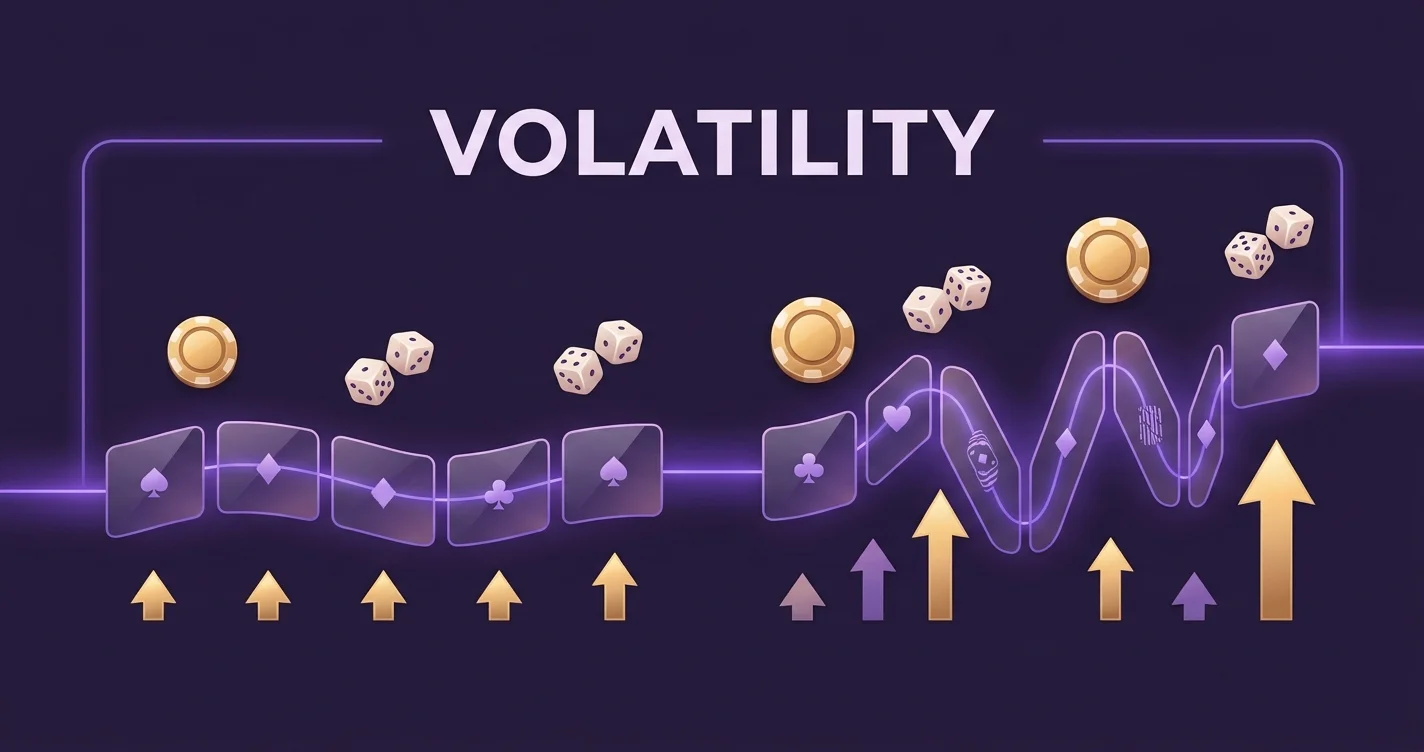
This is the spread of results. The larger the contribution of rare big payouts to the overall RTP, the more the result fluctuates and the higher the volatility. Real slots are more complex: multiple reels, paylines, multipliers, bonus rounds. But the principle is the same: number, table, result.
The key property: spins are independent
Every spin is a separate event. The generator does not remember what happened before and does not adjust the next result to the previous ones. In our example, the chance of hitting "x50" is always 1%: after 5 spins, after 500, and right after an "x50" has just landed.
Several consequences follow:
- there is no "schedule" on which a slot pays out;
- streaks of consecutive losses and consecutive wins are normal for a random process;
- no bet management strategy changes the probabilities within the game itself.
Common myths about RNG
"The slot hasn't paid for a long time, so it will pay soon"
This is the so-called gambler's fallacy. If a coin has landed heads five times, the chance of heads on the sixth toss is still 50%. It is the same with a slot: a long streak without a win does not build up a "debt" that the slot has to repay.
"There are hot and cold slots"
A slot may seem "hot" after a few successful sessions, but that is just a memory of coincidence. Statistically, the probabilities do not change. Differences between games do exist, but they are built into the mathematical model (RTP, volatility), not into the machine's "mood".
"You can press stop at the right moment"
The stop or quick spin button only changes the speed of the animation. The result is already determined at the moment the round starts, so it is impossible to "hit" a lucky moment.
"Big (or small) bets increase your chances"
Bet size scales the payout, but not the probability of combinations. The chance of a hit in the base mode is the same at UAH 5 and at UAH 500. The exception is games where the bet directly changes the rules (for example, an extra option for an additional fee), but this is described in the terms of the game itself.
"The casino manually tweaks the results"
In fair games from certified developers, the result is determined by the RNG, and the operator cannot interfere with an individual round. The guarantee is an independent audit of the generator and the mathematical model. This is general market practice: laboratories check that numbers are distributed evenly and that the actual RTP matches the declared one. But an audit concerns the fairness of the algorithm, not your personal result: a game can be perfectly fair and still be a losing one for the player on average.
Where else RNG is used
- Slots. It determines symbol positions on the reels, the appearance of scatters and the triggering of bonus features.
- Virtual table games. Roulette, blackjack and baccarat in RNG versions use a generator instead of a physical wheel or deck.
- Crash games. The generator determines the moment the multiplier "crashes". Some of these games add a fairness check (provably fair), where the player can verify the result using a hash code.
- Live games. These usually feature a real wheel, real cards and a live dealer, so the RNG plays a smaller role. However, in some formats (multipliers, bonus rounds) a generator is still present.
RNG and bonus features
Triggering a bonus round is also the result of the generator's work: when enough scatters land, free spins are launched. The chance of this happening is small and fixed by the game model. The bonus buy mode lets you skip the wait and pay to enter the bonus directly. But the generator inside the bonus works the same way: the payout is still random, and you pay a higher price per round for the quick access.
Typical player mistakes
- Looking for patterns. Recording results and deriving a "system" is pointless: for random independent events, the past predicts nothing.
- Raising the bet after losses. An attempt to "win it back" relies on the same fallacy. The probabilities haven't changed, while the risk of losing more has grown.
- Confusing the short and long run. A 96% RTP does not mean you will get back 96% in one evening. It applies over a very large number of rounds, and in a short session the result can be much better or much worse.
- Treating a winning streak as a sign of skill. In RNG-based games, chance determines the result, not skill.
- Believing in "guaranteed" schemes. Any offer to "hack the RNG" or predict a slot is a scam. Paid "signals" and "predictor programs" cannot work against a properly functioning generator.
How RNG affects your decisions
Understanding the generator helps you assess a game soberly:
- Look at the parameters, not the feeling. RTP, volatility and hit rate genuinely describe a game, unlike the subjective "the slot is hot".
- Set your budget in advance. Since the result of a short session is down to chance, limit the amount you are ready to spend before you start playing, not during.
- Don't try to "win back" a loss. The next spin does not depend on the previous ones, so it doesn't "owe" you a return.
- Treat gaming as entertainment. A mathematical edge is built into every game, and the RNG only distributes results around that average.
- Read bonus terms separately from game mathematics. The generator does not affect wagering requirements. You can read about how they work in the article on wagering.
Responsible gambling
Knowing about RNG does not give you a way to win, it only helps you avoid believing in myths. The result of each round is random, and nobody can guarantee a win. You can play only from the age of 18. The same rule applies at Rich Top: 18+ is set out in the site's terms of use. If you notice that you are playing more than you planned, or trying to "win it back", take a break. At RichTop there is self-exclusion for a period from 6 months to 5 years, along with tips for controlling your play.





 Google

 Payment History