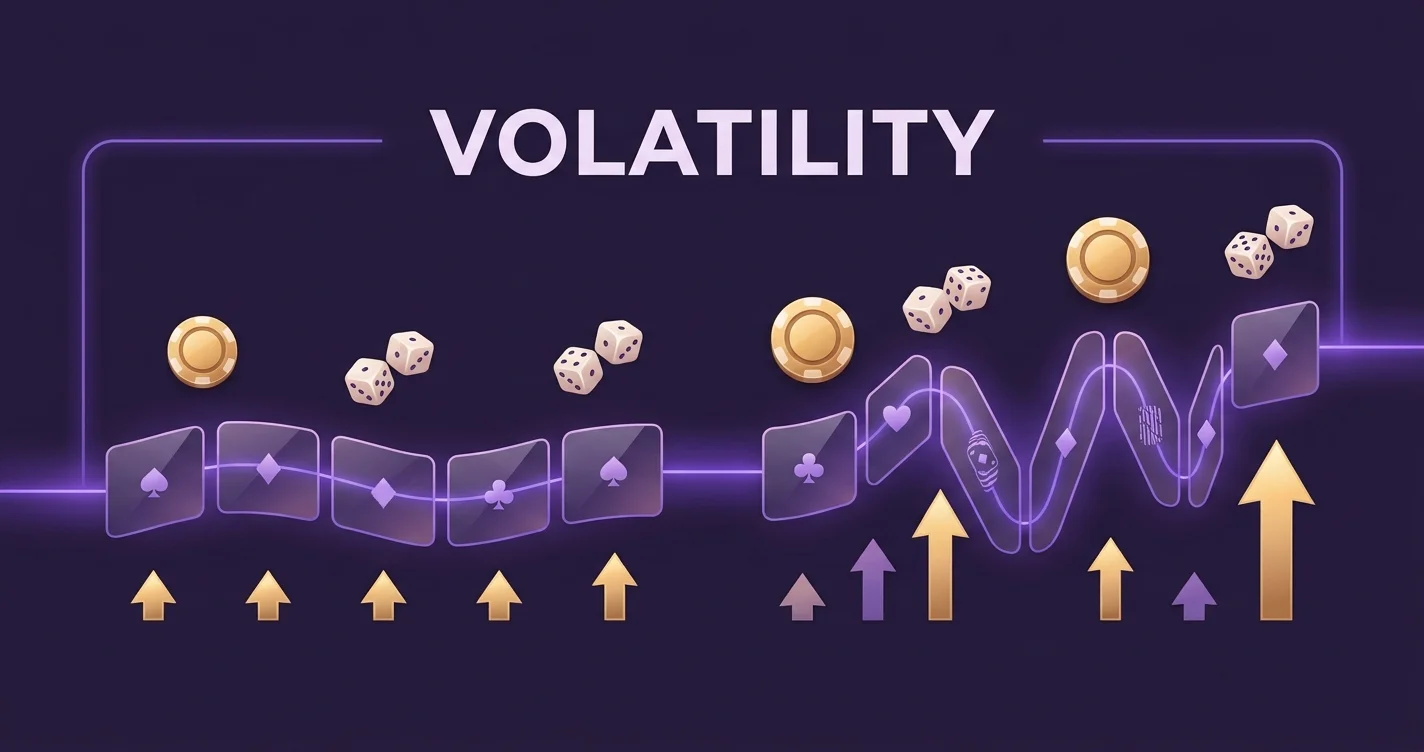
Volatility (also called variance) shows how far a game's results deviate from the average. In a low-volatility game, wins are small and frequent. In a high-volatility game, they are rare but can be much larger than the stake. Volatility does not change a game's theoretical return; it only determines how "unevenly" the game gets there.
How it works in simple terms
Imagine two players spinning different slots with the same return percentage. One gets small wins almost every time, and the balance slowly drifts up or down. The other sees nothing for a long time, then suddenly lands a win worth dozens or hundreds of stakes. Both games can have identical math, but the experience is completely different.
Every game has:
- win frequency: how often a spin returns anything at all;
- win size: how much that is on average, measured in stakes;
- the "tail" of the distribution: how much rare but large payouts affect the overall result.
High volatility means a significant part of the return is "hidden" in rare big wins. As a result, most short sessions end in a loss, while a small share end with a big profit. In low-volatility games, sessions look more like one another.
Volatility levels
There is no single official scale. Developers usually label a game as low, medium or high, and sometimes add intermediate grades. This is a guideline, not an exact number, and labels from different studios should be compared with caution.
| Level | What wins look like | How the game feels |
|---|---|---|
| Low | Frequent, small, rarely much larger than the stake | Calm, the balance changes slowly, a longer session on the same amount |
| Medium | Moderately frequent, with occasional noticeable payouts | The balance visibly "swings", but without long empty streaks |
| High | Rare, but capable of far exceeding the stake | Long streaks without wins, sharp jumps, a quickly lost bankroll |
An example with numbers
Let's take two hypothetical games with the same 96% RTP (more about this metric in the article on RTP). The stake is 10 UAH, 100 spins, so the turnover is 1,000 UAH. This is a simplified model, not real slots.
- Game A (high volatility): once per 100 spins the payout equals 96 stakes (960 UAH), otherwise nothing. Expected value: 0.01 × 96 = 0.96, i.e. 96%.
- Game B (low volatility): once per 4 spins the payout equals 3.84 stakes (38.4 UAH). Expected value: 0.25 × 3.84 = 0.96, also 96%.
In theory, both games return 960 UAH per 1,000 UAH of turnover. In practice:
In Game A, the probability of getting no win at all in 100 spins is about 37%. Then the session ends with a complete loss of 1,000 UAH. Roughly the same 37% yields exactly one win of 960 UAH, and the result comes out almost break-even. The remaining ~26% of cases give two or more wins, which is already a profit. The results are very widely scattered.
In Game B, about 25 wins of 38.4 UAH are expected. In roughly two sessions out of three, the number of wins will be between 21 and 29, which gives a return of about 806 to 1,114 UAH. The results cluster close to the average.
Conclusion: the same return does not mean the same experience. Game A can "wipe you out" in a few minutes, while Game B rarely produces either a very big loss or a very big win in a short session.
Volatility, RTP and the house edge
These concepts are often confused, although they describe different things:
- RTP tells you how much of all wagers a game returns to players on average over a very long run.
- House edge is the flip side of RTP: the share the game keeps for the operator on average. At 96% RTP, it is 4%.
- Volatility describes the spread of results around that average, that is, how "jerky" the path to it is.
High volatility doesn't make a game more profitable, and low volatility doesn't make it safer in terms of math. The house edge works the same in both cases. Only the risk of short-term swings changes.
How to tell a game's volatility
- A label in the game description or info window. Many studios state the level directly. If it's missing, look in the rules section.
- The paytable. If the gap between payouts for low and top symbols is very large, and most of the potential sits in bonus features, the game is most likely high volatility.
- Bonus rounds. If most of the winning potential "lives" in rare bonus rounds (for example, after scatters land), this is usually a sign of high volatility.
- Your own observation. A few dozen spins at the minimum stake, or in demo mode if available, will show how often the balance "comes alive". But this is not an exact measurement: a short sample can be very misleading.
How volatility affects your choice of game
Stake size and bankroll
The higher the volatility, the smaller the stake should be relative to your budget. If your bankroll only lasts 50 spins, high volatility can end the session before even one big win comes through. Low volatility gives more spins for the same amount, but you shouldn't expect a big win.
A practical rule: decide in advance how much you're willing to spend, and choose a stake so that you get at least a few hundred spins on the chosen game. For high volatility, make the stake even smaller.
Your goal in playing
- If you play for duration and entertainment, low or medium volatility is a better fit.
- If you enjoy tension and are consciously prepared for a losing streak, you can choose high volatility, but with a smaller stake.
Bonuses and wagering
When wagering a bonus, what matters is not only the return percentage but also whether your balance can survive an "empty" streak. The wagering terms are described by the wager: you must place bets totaling a certain amount, and the higher the volatility, the greater the chance that the balance runs out before the wagering is complete. Low and medium volatility usually carry you through the requirement more steadily, but there are no guarantees. Always read the bonus rules before wagering, including which games count and what stake you can play with.
This also applies to bonuses at Rich Top, where wagering terms depend on the specific offer. So before activating one, check the wager and the game restrictions.
Bonus buy
The bonus buy feature lets you buy entry into the bonus round for a fixed number of stakes. Such a purchase usually widens the spread of results: you pay a large amount at once, and the return can be either much lower or higher than the price. Even with a stake that seems "small", the purchase amount can be very significant, so it should be factored into your budget.
Common myths
- "The slot hasn't paid for a long time, so it will pay soon." No. Every spin is independent; the game doesn't "remember" previous results and doesn't catch up to the average.
- "High volatility means a high chance of a big win." Quite the opposite: big wins are possible but rare. That's exactly why most sessions in such a game end in a loss.
- "Low volatility guarantees I won't lose." No, it only reduces the spread. The house edge works here too.
- "There's a time of day or a strategy when volatility changes." Volatility is built into the game's math and doesn't depend on the time, the size of your balance, or the number of spins in a row.
- "I raise my stake after losses to win it back." This is the path to rapidly growing losses, especially in high-volatility games.
Typical player mistakes
- Choosing high volatility with a small balance and a large stake.
- Judging a game by a few dozen spins and concluding it is "generous" or "stingy".
- Confusing volatility with RTP and thinking one compensates for the other.
- Continuing to play to "wait for the bonus" when the limit has already been used up.
- Failing to account for the cost of a bonus buy or wagering requirements when planning a budget.
Volatility and responsible gambling
High volatility creates a "near miss" effect and long streaks without results, which easily lead to impulsive decisions. Set limits on time and money in advance and don't exceed them, even if the session is going badly. You can play only from the age of 18, and gambling should be seen as entertainment, not a way to make money.
Bonuses such as cashback or rakeback don't cancel the game's math. Cashback at RichTop returns part of your losses depending on your VIP level, and rakeback is calculated from real bets, but this is only partial compensation, not a guarantee of results. If you feel the game is getting out of control, use self-exclusion at Rich Top: it's available for a period from 6 months to 5 years. It's also worth turning to professionals or loved ones for help.
In brief
- Volatility describes the spread of results, not the average return.
- High: rare but large wins and long "dry" streaks. Low: frequent, small wins.
- With the same RTP, short sessions can look completely different.
- Choose your stake to fit your bankroll and the volatility level, not the other way around.
- Volatility doesn't give you a strategy to "beat" the casino and doesn't guarantee a win.





 Google

 Payment History